In awe of Graphic Design
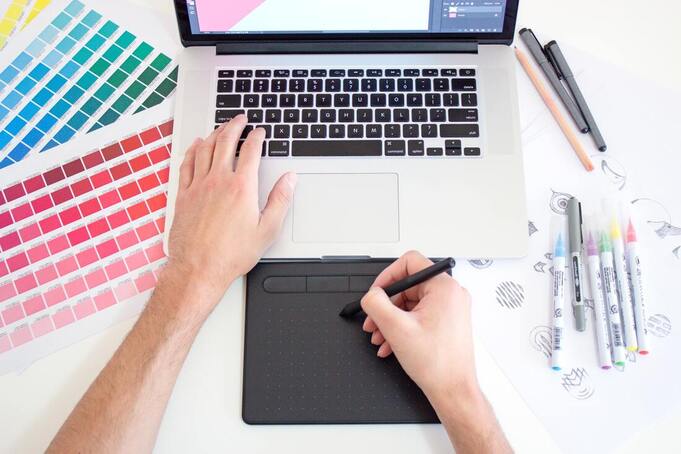
In the summer of 2018, I enrolled in a graphic design course at the 'Dublin Institute of Design'. Having always been interested in art, design, technology etc., and considering some of the work I had been doing while designing and developing my teaching materials, I felt it was a course I could learn a lot from. Great to be a student again too, seeing assessment briefs, using VLEs, engaging in peer learning and receiving feedback to enhance my work.
My first day arrived....I commenced with my backpack full of the required materials, eager to get going. I met my new classmates, some of whom had degrees in fine art (very different from my molecular biology background!). I was immediately struck by just how much a scientist stood out in a room of talented creatives, designers and artists 😀
Having worked with a truly excellent graphic design team on a certain project in recent months, it brought back memories of my course and I reflected on considering ten things I learned from being a graphic design student back then.....
I appreciate graphic designers more than I could ever verbalise. Many roles come with a desired skill set. We are familiar with this concept. Imagine a role where a client has a brief, an idea, perhaps something they are not entirely sure of - but they want you to see through the 'fog', find the solution, build it and deliver it - while also ensuring it was what they had in mind all along (and this can change a lot along the way too!). Well add in talent, creativity, dedication, experience, skill, technology confidence and competence, inspiration, trial and error and you are beginning to realise the role of a graphic designer. Don't forget the expense of time, computers, cameras, printing, software are also needed.
The importance of a sketch book. A vital piece of kit for any designer. It's where ideas are born, thought processes are captured, with designs often created from early stage doodles. YouTube is filled with people showing their sketch books, like mini-portfolios. I invested in a several, and still use them today. If you want a nice digital version to doodle and sketch - check out the Procreate app on the iPad if you have the apple pencil - fantastic app.
Colours and printing is a complex art (have you heard of pantone's colour language?!). We are so used to pressing print and getting a copy of our images/designs/logos etc. However, a lot goes on behind the scenes to ensuring that it is as close to the digital version. It's a science, an art and requires more awareness than I ever realised. A lecturer on the course had a small book of the various Pantone shades (a formula guide) and said it was one of her prized possessions! It's almost the equivalent of a Dulux paint colour book, but quite pricey. Pantone's universal language can ensure everyone is working with the exact same shade of a colour - they even have a 'colour of the year' award! Each of the colour boxes on this post are actually previous Pantone colours of the year!
A logo has to work in black and white. This really hit home during one of my projects. No point in designing a great logo, that someone prints or photocopies only for it to be lost or faded. Of course the final version can be in colour, but you have to ensure it contrasts well and is going to work well in black and white. Incorporating this mindset early in the design process can be of help.
Palettes can be your friend. Finding colours that work and complement each other isn't always an easy task. The 'colour wheel' can be of help around this, but having a palette of colours is always a nice option to be able to draw from. Adobe has software to generate a palette from your main colour of interest. It can make everything look so connected, with colour harmonies, for example on a website, or with a brand.
I love typography! I always knew I liked 'Type'. We have all heard the story of Steve Jobs and him dropping in to classes around this topic. However I never realised just how much I loved typography. It's everywhere around us, everywhere. The next time you go to the shops, just look at the chosen font (typeface) for the store front. It can even create an 'perception' in you of the type of place it is. For example a jewellers will have a very different font compared to a coffee shop. I had a project on one particular typeface that really opened my eyes (idea for future blog post now established!)
There is something satisfying about seeing a truly impactful logo and appreciating its design. Oh that magical feeling when a plan comes together, the realisation when the design comes together from all the previous versions, iterations and workings. It's such a special moment. Of course it's the customer or client who will ultimately tell you if it's final, but you know the joy in seeing your work come together. I also loved seeing good design online, and learning about certain case studies. There are an abundance of excellent examples, but one that reflects what I'm describing is when Blattner Brunner, working to help Lego, developed an incredible shadow series of ads that was jaw dropping. Equally, a simplistic logo (some even textless) can be iconic, yet can take years to develop. For example, Nike, FedEx, Amazon, Toyota, PlayStation, Shell are some familiar examples.
Go to the computer last. When I landed on on day 1 of the course, we were sketching still life initially. Where was the cool Adobe tutorial? Why aren't we conquering the tech side of things? Well I learned fast that with design, the computer aspect comes in at the end. Of course a vital element, in the work I did, the sketch book and trial/error all led to the ideas emanating from the pages before going to power up the iMac!
Adobe Illustrator's line tool takes work, but it's worth the investment. I sat beside someone on the course one day who started crying because of the pen tool! It's an incredibly powerful tool on illustrator, but one that needs perseverance. Have faith, you will get there - and like learning to drive, how you use it will ultimately become natural!
Reach for and listen to feedback (from more than one person!). We had two lecturers on our course, and what was striking was how different their styles or approaches to design were. They contrasted on many levels, yet connected on others. As a student, it was excellent to learn different approaches and see the benefit of getting feedback from these viewpoints. Feedback is essential, and getting a completely fresh set of eyes to review and make suggestions is a valuable mindset to adopt - as well as maintaining an openness to receiving constructive criticism. Ultimately, you are going to get feedback from your client/customer, so it's good to have this in your normal workflow too. Design can be very subjective (but don't forget, your design is always the best, even if they don't like it 😉😂)!
From my experience, it was incredible to work on ideas, iterations of ideas, new ideas, etc. and then you began to see an idea shine through. It's a real eureka moment. We learned in some cases, it can occur in minutes (like the 5-minute, napkin drawn, $1.5m design of the Citibank logo by the incredible Paula Scher) but this is extremely rare, and normally takes a considerable length of time.
So even though tools such as 'Canva' can provide incredible tools for quick design tips for people to get by, a graphic designer and their incredible talent is creative, unique and should be treasured. From completing my graphic design course, I will never undervalue the contribution and skill of a graphic designer.
So even though tools such as 'Canva' can provide incredible tools for quick design tips for people to get by, a graphic designer and their incredible talent is creative, unique and should be treasured. From completing my graphic design course, I will never undervalue the contribution and skill of a graphic designer.
Photo by Theme Photos on Unsplash