Micro-Credential Group Work; Tips for Success from a Student Viewpoint
CONTEXT
As part of a micro-credential course I completed earlier in 2022 on Strategic Management, there were two dedicated assignments, the second of which was a team submission (i.e. assessed group work!). Having previously been a member of several working groups in my normal role, centred around understanding and enhancing assessed group work, with one group developing institutional guidelines around this, and all being complemented by employing formative and summative group work in my modules etc., I was fascinated to see how I would now fare being a student in such a scenario. Of course, to add another slant to this, it was online, virtual group work with my team member based on the other side of the country.
Amongst any group, there are different personalities that come together, with the concept of bringing different strengths and ‘lenses’ to an assignment or to a problem solving situation. However, approaches can differ across members which can be a potential source of stress and anxiety for many learners. For example, consider someone who likes to start an assignment immediately upon getting the brief, as opposed to someone who is comfortable to pull everything together just as the deadline approaches. Differing approaches such as these can cause anxiety - in both instances noted above. However, as we champion employability, power and transversal skills, we do all realise the need and potential for learning how to communicate and succeed as a team.
Amongst any group, there are different personalities that come together, with the concept of bringing different strengths and ‘lenses’ to an assignment or to a problem solving situation. However, approaches can differ across members which can be a potential source of stress and anxiety for many learners. For example, consider someone who likes to start an assignment immediately upon getting the brief, as opposed to someone who is comfortable to pull everything together just as the deadline approaches. Differing approaches such as these can cause anxiety - in both instances noted above. However, as we champion employability, power and transversal skills, we do all realise the need and potential for learning how to communicate and succeed as a team.
Perhaps my experience of this virtual group assignment may be familiar to some students, and hopefully the tips collated will support others on a similar path to me. I know I'll be even more mindful in my own teaching now, of what learners are going through and dealing with.
EMOTIONS I FELT BEFORE IT EVEN STARTED
As the topic/discipline area was new to me and one I was learning more about, the obvious emotion was around being worried I could let the team down due to this lack of expertise. However, this soon turned in to a motivational energy, one that meant I was determined to ensure I contributed and supported the cause and goals of the team. The prior assignment had been an individual one and it meant I was solely responsible for that, and that felt fine to me at the time, especially in this new discipline area. Also, it meant I could work to my own schedule, design my own content, focus on specific areas, correct errors, etc. in that instance.
Another concern was about how as a group of people, each working full time, would we manage the process of finding time in the evenings to meet virtually (and balance that with kids/life/work/hobbies/different schedules etc.), and would we even have similar mindsets or space to allow this to occur? I figured asynchronous approaches were always possible to counter any such difficulties, but it’s good to be able to talk things out too. Logistics came in to play also, how would we communicate/use a shared space etc. Would a system I liked and was familiar work for the team? Would they have access to the system the same way I would? How would we track document versions, updates, comments etc. in a platform everyone was happy and comfortable to engage with.
Another concern was about how as a group of people, each working full time, would we manage the process of finding time in the evenings to meet virtually (and balance that with kids/life/work/hobbies/different schedules etc.), and would we even have similar mindsets or space to allow this to occur? I figured asynchronous approaches were always possible to counter any such difficulties, but it’s good to be able to talk things out too. Logistics came in to play also, how would we communicate/use a shared space etc. Would a system I liked and was familiar work for the team? Would they have access to the system the same way I would? How would we track document versions, updates, comments etc. in a platform everyone was happy and comfortable to engage with.
So, overall, I can relate how anxiety could easily take a hold over someone involved in group work - and interesting to note, for me a lot of this occurred before the work actually commenced! I still had all the work and deadline driven anxiety to manage yet :-)
REFLECTING ON THE EXPERIENCE & WHAT I LEARNED
Looking back, it actually ended up being a very enjoyable and rewarding experience. As you often read, sometimes the best learning is in the journey/process itself, as opposed to the destination/product. In the team or group I was assigned to (working with a super classmate, Niamh Harte), we each brought our own expertise that really helped support the other person, as well as benefit the final output. Our differing career paths and experiences had provided alternative skills and expertise, but together we were stronger for sure. I consider myself very fortunate that my teammate was equally motivated to get going with the project and we kept the pressure on, I mean motivating(!), each other - in a good way - by ensuring regular catch ups were consistently scheduled and also kept updating each other via WhatsApp, so we were in constant communication on progress.
How well we worked together is typified by how we submitted the assignment over 3 days early! We were keen to ensure we managed to enjoy a bank holiday with our respective families, so we really pushed ourselves over the final weekend to do the last edits, proof reading etc. before submitting early. That is just one wonderful example of how well we worked together on this, we had a focus and target and met it. I learned a great deal about the topic at hand, and there was a lot of learnings from the process of the group work too (mentioned above). You could also say that as professionals, investing your own time and money in to the course is a motivator - and I’m sure that plays a role in the ‘drive’ you have to complete everything - but it can be more difficult than you think to carve time out for the group work, with life, kids, hobbies, surprises and of course your own work demands. Some flexibility and appreciation of others’ situations is key - so always be respectful, nice and understanding of others' circumstances.
How well we worked together is typified by how we submitted the assignment over 3 days early! We were keen to ensure we managed to enjoy a bank holiday with our respective families, so we really pushed ourselves over the final weekend to do the last edits, proof reading etc. before submitting early. That is just one wonderful example of how well we worked together on this, we had a focus and target and met it. I learned a great deal about the topic at hand, and there was a lot of learnings from the process of the group work too (mentioned above). You could also say that as professionals, investing your own time and money in to the course is a motivator - and I’m sure that plays a role in the ‘drive’ you have to complete everything - but it can be more difficult than you think to carve time out for the group work, with life, kids, hobbies, surprises and of course your own work demands. Some flexibility and appreciation of others’ situations is key - so always be respectful, nice and understanding of others' circumstances.
Technology assisted us also. For example, we used WhatsApp for regular updates and communications, Zoom for online catch ups and to review various documents together via screen share, Microsoft OneDrive as a shared space with folders for the various aspects of documents etc., Microsoft word’s track changes/comments functionality to indicate suggestions/potential edits and of course the Moodle virtual learning environment to access course materials and to ultimately, submit.
Both of us had acquired a lot of various experience over the years, so our approach would indeed be quite different to someone starting their first group work assignment. Other elements could really support learners in this instance, for example, there is a lot of evidence both anecdotally and in the literature of groups agreeing contracts at the outset, assigning roles which rotate, taking minutes and developing actions etc. These, along with educator supports, mentoring and monitoring, can really support the groups succeed.
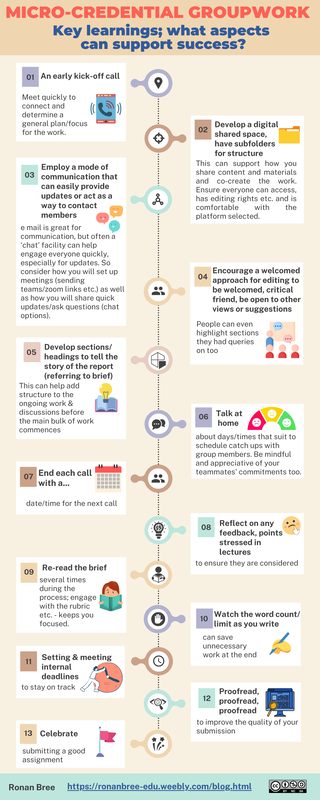
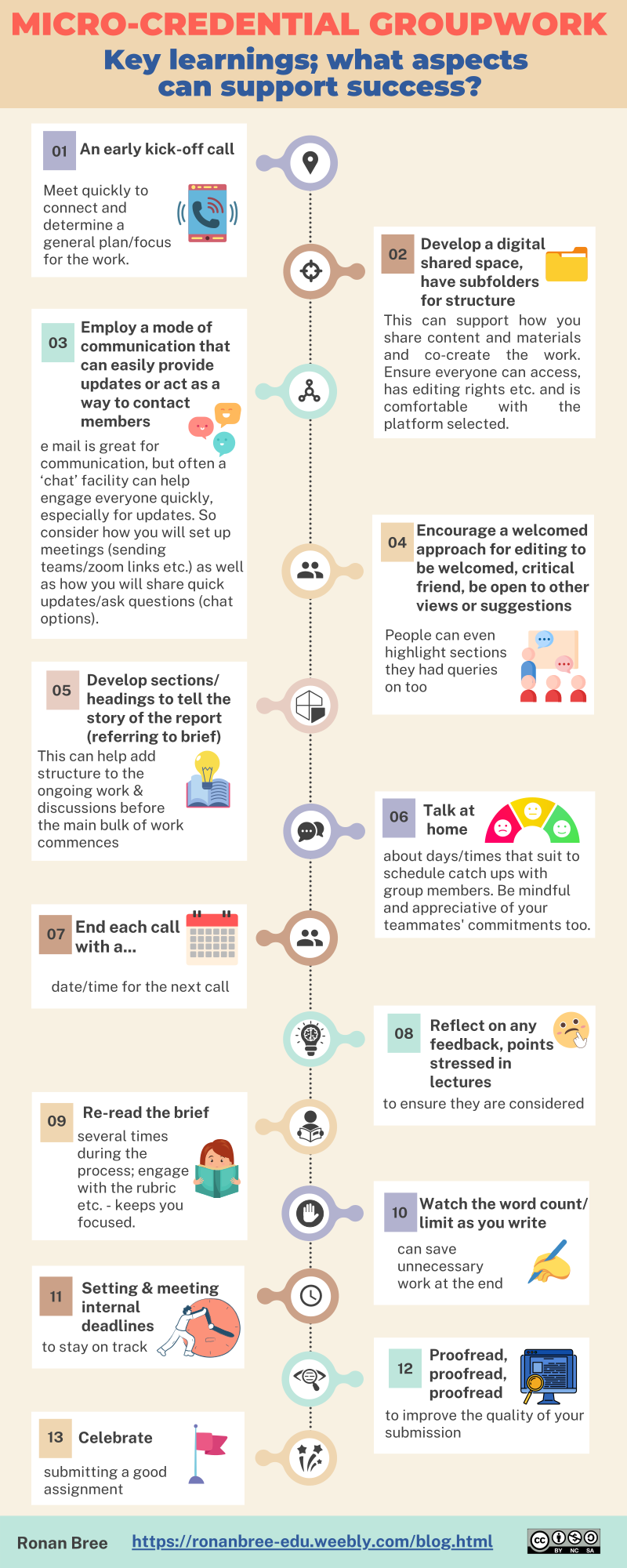
Overall, a very worthwhile experience for me to undertake, for several reasons. Personally, I learned a lot from it, and being part of a team really focused me. Through reflecting, several aspects come to mind as having truly supported our overall success, and I detail some of those below in text and Infograph format for your consideration (click Infograph for full sizes, or download PDF/SVG versions). The high grade we received at the end justified the collective efforts we both put in to this assignment, and the pride and high-quality output generated too.
In the ever-present motivational words of Dr. Terry Maguire (former Director of the National Forum)....
‘We are stronger and smarter together’.
KEY LEARNINGS; SOME KEY ASPECTS
TO SUPPORT STUDENT SUCCESS
- An early kick-off call; meet to connect and determine a general plan/focus for the work.
- Develop a digital shared space, have subfolders for structure; this can support how you share content and materials and co-create the work. Ensure everyone can access, has editing rights etc. and is comfortable with the platform selected.
- Employ a mode of communication that can easily provide updates or act as a way to contact members generally; e mail is great for communication, but often a ‘chat’ facility can help engage everyone quickly, especially for updates. So consider how you will set up meetings (sending teams/zoom links etc.) as well as how you will share quick updates/ask questions (chat options).
- Encourage a welcomed approach for editing to be welcomed, critical friend, be open to other views or suggestions. People can even highlight sections they had queries on too.
- Develop sections/headings to tell the story of the report (referring to brief). This can help add structure to the ongoing work and discussions before the main bulk of work commences.
- Talk at home about days/times that suit to schedule catch ups. Be mindful and appreciative of your teammates' commitments too.
- End each call with a date/time for the next call.
- Reflect on any feedback, points stressed in lectures to ensure they are considered.
- Re-read the brief several times during the process; engage with the rubric etc. - keeps you focused.
- Watch the word count throughout; can save unnecessary work at the end.
- Setting internal deadlines to stay on track.
- Proofread, proofread, proofread to improve the quality of your submission.
- Celebrate submitting a good assignment!