Thinking about applying for an AdvanceHE Fellowship? Here’s what you need to know
Why I’m writing about this…
As the Institute Lead for N-TUTORR at Dundalk Institute of Technology (DkIT), I was involved in DkIT joining AdvanceHE as an institutional member through the programme. The Institute has benefitted from quite a few aspects of that membership, but one area we led out on, again via N-TUTORR, was around their Fellowship programme. We put out an open call to all staff, and over a two-year timeframe, put supports in place to help 26 colleagues submit their applications. I co-ordinated the local supports with terrific input and sharing from colleagues, getting the group together on many occasions so we could exchange and support each other on the journey (with thanks to Ciara O'Shea for helping coordinate the initial stages too). I also submitted my own application as part of the group and was successful with my PFHEA. So I suppose I’ve had two vantage points: my own application, and working alongside a very dynamic and motivated group of people from across all functional areas of DkIT. It’s tremendous to see where we are now as a cohort. As I write this, 16 people have their awards and the other 10 have their applications with panels and under review. Hopefully we’ll have all 26 through and awarded in the very near future.
So when people ask me, “I’m thinking about going for Fellowship, where do I start?” (and I get asked this a lot), the first thing I tell them is that it can feel quite daunting at the very beginning, and will take time and commitment (FYI - my PFHEA took me approx 4 months on top of work, life and family). Getting your head around what’s required, and how to actually get going, takes effort. That’s normal, and we all experienced it. So it’s ok to feel that way at the start. As a group, we were very lucky to have Lisa Donaldson join us for two sessions at the very beginning (thank you Lisa!), as well as have an introductory session with AdvanceHE. In Lisa's sessions, she mapped out her own experience of engaging with Fellowship process, as well as running programmes in DCU and supporting other institutions too. This really helped everyone see the road ahead. Be kind to yourself, give yourself the space to work on this, and don’t be afraid to reach out across your network for guidance or look up exemplars online to see how others have approached it. Hopefully this guide will help you too!
So when people ask me, “I’m thinking about going for Fellowship, where do I start?” (and I get asked this a lot), the first thing I tell them is that it can feel quite daunting at the very beginning, and will take time and commitment (FYI - my PFHEA took me approx 4 months on top of work, life and family). Getting your head around what’s required, and how to actually get going, takes effort. That’s normal, and we all experienced it. So it’s ok to feel that way at the start. As a group, we were very lucky to have Lisa Donaldson join us for two sessions at the very beginning (thank you Lisa!), as well as have an introductory session with AdvanceHE. In Lisa's sessions, she mapped out her own experience of engaging with Fellowship process, as well as running programmes in DCU and supporting other institutions too. This really helped everyone see the road ahead. Be kind to yourself, give yourself the space to work on this, and don’t be afraid to reach out across your network for guidance or look up exemplars online to see how others have approached it. Hopefully this guide will help you too!
What is the AdvanceHE Fellowship?
As per the Advance HE website, the Fellowship concept demonstrates “a personal and institutional commitment to professionalism in learning and teaching in higher education.” There are four categories, each recognising your practice, impact and leadership of teaching and learning: Associate Fellow (AFHEA), Fellow (FHEA), Senior Fellow (SFHEA) and Principal Fellow (PFHEA). Fellowship is awarded based on evidence of your own professional practice measured against the Professional Standards Framework 2023 (PSF 2023). The category you go for depends on which of the framework’s four 'Descriptors' best matches your practice and experience. It’s also a big and growing community - by early 2025, Advance HE had passed 200,000 Fellows worldwide, with more than 19,000 based in institutions across 116 countries outside the UK, and the numbers here in Ireland are growing too.
Get to know the supports, and the framework (...very well!)
AdvanceHE have really supported the Fellowship process with a lot of online resources, and it’s worth knowing what’s there before you begin. Their Fellowship web pages are a really good starting point. There’s a Category Tool, which you complete to work out what level you should really be aiming for. There’s the Connect platform, where you can network with other people who are in that space and share experiences. AdvanceHE also offer (paid) supports for anyone considering applying. Then there’s the PSF 2023 itself, an application guide for each category, and template documents for pretty much everything.
My advice is to download the relevant level’s application packs and really spend time getting to know its contents. Get to appreciate the framework, the various dimensions within it, and where your work sits. Then think about how you’re going to evidence that, because demonstrating your practice, and the evidence behind it is key. There are particular ways to approach how it’s written, and a lot of that is covered in the application pack’s documentation. But whatever level you’re going for, your evidence is going to be critical to support any claims being made.
You’ll also need advocate statements to support your application, so be very mindful about who you pick. It needs to be someone who has real experience of working with you and can speak to the impact of you and your work. Give them plenty of advance notice, because they will need to see your final application before they can write their statement. And it’s not just a paragraph: an advocate statement is a one-to-two-page document. So do respect their time, availability and workload.
AdvanceHE membership: what it means for you as an applicant
There are different types of Advance HE institutional membership, and depending on what’s in place in your institution, there can be different fee structures available. For example, some institutions have accredited schemes or programmes, which means they assess and award Fellowship themselves (sometimes only for particular categories) under an agreement with AdvanceHE. In the majority of cases, though, the institution pays the membership and AdvanceHE coordinates and carries out the evaluations of applications. It’s worth being mindful of which applies to you (in DkIT, at the time of writing, we continue to be a member of AdvanceHE). Note - note what I am outlining in this post is relevant to direct AdvanceHE submissions...if a formal programme is in place in your institution, do ensure you follow local and agreed requirements.
Beyond Fellowship, being an institutional member gives you access to various reports, platforms, communities and awards, and recognition opportunities. Ultimately, it connects you to a community across several sectors and countries - that is very international and highly recognised. I think that’s a key feature.
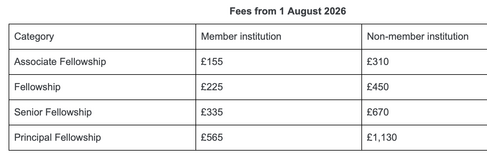
Institutional membership also matters when it comes to the cost of submitting a Fellowship application. If your institution is a member, the member rate is effectively 50% cheaper than the non-member rate, so all of a sudden you’re getting your submission at half price. It’s worth reviewing the fees on the AdvanceHE website before you do anything so you’re aware of what you’re committing to pay (see rate table below, from 01 Aug 2026). A lot of the time the fee comes at personal cost, unless your institution has certain programmes in place to cover it - but this is often rare. That’s very much institution-dependent, so you could be looking at paying some of the fee yourself.
Pick your category, then plan
Once you’ve identified the level you’re applying for, it really focuses your mind. You look at the framework and its dimensions in a particular way, and you begin to start mapping your application out. If you can, find an accountability partner. If it’s someone doing a similar application, great: you can keep each other motivated and meet regularly. Even if it’s a friend, ask them to hold you to tasks and dates so that someone is keeping tabs on your progress and you don’t let it slide.
Overall, this is a big commitment. Across our cohort of 26, completion took quite a lot of time for the majority. A lot of the feedback that came back was around the high level of work required on top of normal workload, research projects, programmatic review and of course, family and normal life. All of those become high priority at different points in the year, and they often needed to take precedence over the application. What a lot of people came to realise is that this has to be prioritised by you, because it’s something for you. You will need to carve out proper time and give it real commitment and dedication.
Overall, this is a big commitment. Across our cohort of 26, completion took quite a lot of time for the majority. A lot of the feedback that came back was around the high level of work required on top of normal workload, research projects, programmatic review and of course, family and normal life. All of those become high priority at different points in the year, and they often needed to take precedence over the application. What a lot of people came to realise is that this has to be prioritised by you, because it’s something for you. You will need to carve out proper time and give it real commitment and dedication.
A few things worth being mindful of
- It’s not only for academics. People often look at Fellowship and assume it’s very much an academic/lecturer thing, but it’s not. People from various roles can apply at various levels depending on their experience or area of work, so you can be outside a direct academic role and still achieve Fellowship in some capacity. There’s plenty of evidence of that online – and in DkIT now too!
- There’s a plethora of resources out there. You’ll find exemplars and case studies online that people have shared, podcasts, and lots more that can give you real insight and support your application.
- Watch the timeframe. When you go through your application pack, you’ll see that whatever level you’re going for has a look-back period, and what you’re describing has to fit within it. You can reference things from before that as part of your journey, but your focus has to be on the timeframe highlighted in the guidance documents.
- Word count is very specific. Make sure you stay within it.
Is it worth it?
Massively. It creates connections amongst colleagues. It supports you to reflect - and it helps you see, realise and value the impact you’ve had on your practice and how that’s grown throughout your career so far. It’s internationally recognised, you get letters to put after your name, and there’s a community really growing here in Ireland already. Many successful applicants who receive their Fellowship report that the 'personal journey' of applying is the almost the best part.
It’s also worth being aware of what’s coming at national level. The HEA and the National Forum are developing a National Professional Recognition Framework (NPRF) for teaching and learning in higher education in Ireland, building on the 2016 Professional Development Framework. As that takes shape, it will be worth thinking about how your Fellowship potentially maps to it and where the synergies are too.
It’s also worth being aware of what’s coming at national level. The HEA and the National Forum are developing a National Professional Recognition Framework (NPRF) for teaching and learning in higher education in Ireland, building on the 2016 Professional Development Framework. As that takes shape, it will be worth thinking about how your Fellowship potentially maps to it and where the synergies are too.
So what are your next steps? ...Go for it!
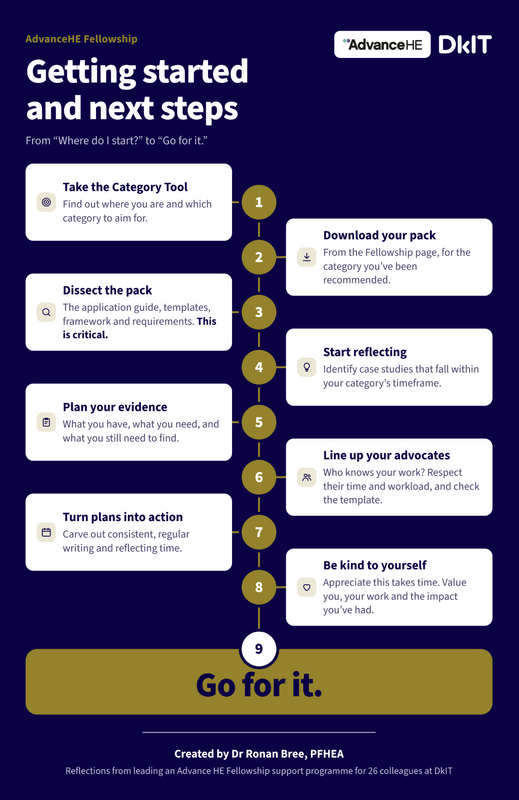
See the Infograph below....
A note on how this was written: This post draws entirely on my own experience of leading the Fellowship support programme at DkIT. It is built on my own personal experiences, reflections, ideas and structure. I dictated my thoughts section by section and used Claude to turn that dictation into written text, keeping my voice, thoughts and the points I'd highlighted as important. I then revised, edited and approved the final version, and the graphics were developed in a similar way. I take full responsibility for the content presented in this post.