Plagiarism, Paraphrasing, Procrastination, Perfectionism & Problems.
As part of my role, each year I design and run tutorial sessions with award year students carrying out literature research projects where one session specifically focuses on ‘Academic Integrity’. It’s become a more and more important session in my view, especially in recent times. Here's an overview of the journey we go on....
Academic Integrity
We begin our session by reviewing what academic integrity is and how it is embedded across all aspects of higher education (and afar). We centre on its importance for institutions, for society, and for a trust in people and quality. I feel it’s important to contextualise this element for students, focusing on slightly familiar aspects such as ethical research, data fabrication etc. It’s almost a life lesson as well as an academic one. Several years ago, I was invited by the library to speak on this topic for a short video, and for some of the elements I mentioned in that video, I bring them to the fore again in this session. For example...giving credit where credit is due, paraphrasing, engaging with high quality and peer-reviewed sources, maintaining an honest and ethical mindset, and most importantly to be proud of your work and efforts.
We begin our session by reviewing what academic integrity is and how it is embedded across all aspects of higher education (and afar). We centre on its importance for institutions, for society, and for a trust in people and quality. I feel it’s important to contextualise this element for students, focusing on slightly familiar aspects such as ethical research, data fabrication etc. It’s almost a life lesson as well as an academic one. Several years ago, I was invited by the library to speak on this topic for a short video, and for some of the elements I mentioned in that video, I bring them to the fore again in this session. For example...giving credit where credit is due, paraphrasing, engaging with high quality and peer-reviewed sources, maintaining an honest and ethical mindset, and most importantly to be proud of your work and efforts.
Promote the right ‘P’ word
We then begin to speak about the ‘P’ word, yes plagiarism. However, I have really tried to reframe the message from “Don’t plagiarise” to “Do paraphrase” - the other ‘P’ word! I guess I’ve noticed the impact of this since becoming a parent…if you say “don’t climb up on the table”, you inevitably find your child on the table a few moments later. Hence, I try to push the positive affirmation around paraphrasing and illustrate a process for the students to engage with. We also review examples of both paraphrased and plagiarised text.
We do review plagiarism detection software platforms in higher education (HE) such as Turnitin and how it functions. I like the students to be aware of what occurs once they press submit. In many cases, they are already aware of software checking their submissions, but are often surprised when I mention we deal with things on a case-by-case basis; that there is no magic % you need to be under to avoid ‘detection’. Our students actually have access to Turnitin, so they are able to use this tool before submitting to learn from the process and educate themselves on the matter.
Contract Cheating
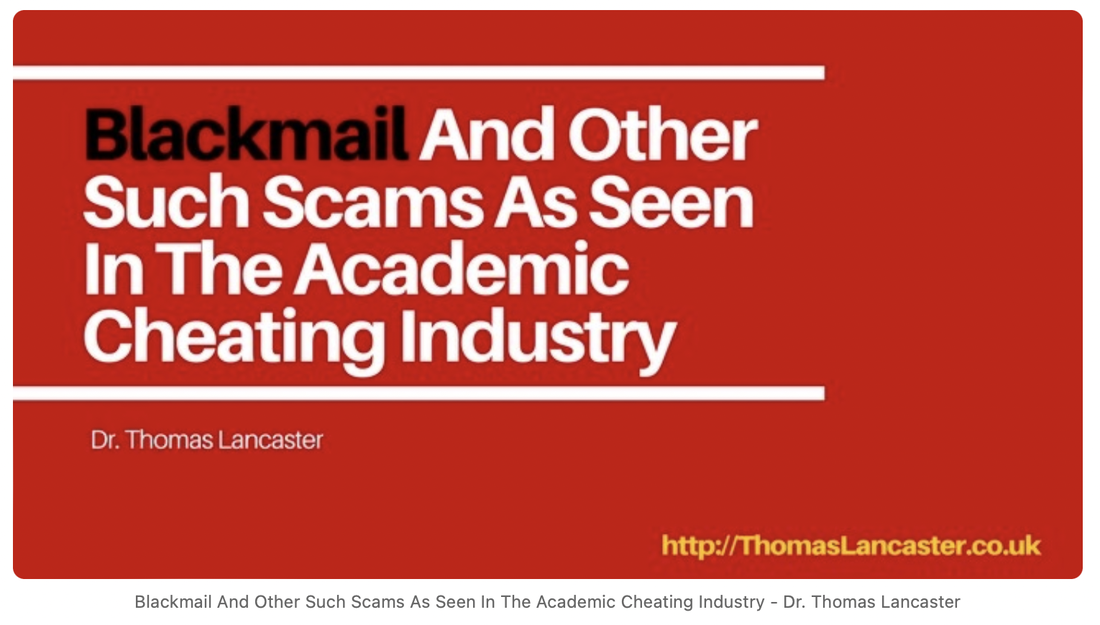
So, following my secondment with the National Forum, this year was my first time delivering this session since attending a National Forum Seminar Series hosted by IT Carlow's Yvonne Kavanagh with the excellent guest presenter Dr. Thomas Lancaster, who was speaking about contract cheating. It was an event which gave me such an important insight in to essay mills, contract cheating, and unfortunately even blackmail. Immediately after this event, I knew I needed to inform, warn and support my students of the associated pitfalls, all framed in the academic integrity topic. I was stunned by the examples highlighted in the session, for example if a student uses social media to mention being behind on an assignment, they are immediately (within seconds) targeted by bots advertising services to help. The company websites often boast of people using their services locally with testimonial statements, even naming the institution sometimes - all geared to further entice. It’s made so easy for students to feel this could get them out of a situation, with multiple upcoming assignment deadlines, they find themselves in. However, there are greater pitfalls which students need to be aware of. In a post by Dr. Lancaster, you can see examples where these companies ‘followed’ the progress of students who use their services, following up with them years later threatening to inform their institution or employer of their wrongdoing unless further funds are sent. The students could be paying such a heavy penalty one (significant) mistake, a potential mistake which I feel we need to highlight and speak openly about as a group. To protect out community, we need to report these platforms where possible. Interestingly, some of my students had noticed such companies appearing on their social media feed.
So, following my secondment with the National Forum, this year was my first time delivering this session since attending a National Forum Seminar Series hosted by IT Carlow's Yvonne Kavanagh with the excellent guest presenter Dr. Thomas Lancaster, who was speaking about contract cheating. It was an event which gave me such an important insight in to essay mills, contract cheating, and unfortunately even blackmail. Immediately after this event, I knew I needed to inform, warn and support my students of the associated pitfalls, all framed in the academic integrity topic. I was stunned by the examples highlighted in the session, for example if a student uses social media to mention being behind on an assignment, they are immediately (within seconds) targeted by bots advertising services to help. The company websites often boast of people using their services locally with testimonial statements, even naming the institution sometimes - all geared to further entice. It’s made so easy for students to feel this could get them out of a situation, with multiple upcoming assignment deadlines, they find themselves in. However, there are greater pitfalls which students need to be aware of. In a post by Dr. Lancaster, you can see examples where these companies ‘followed’ the progress of students who use their services, following up with them years later threatening to inform their institution or employer of their wrongdoing unless further funds are sent. The students could be paying such a heavy penalty one (significant) mistake, a potential mistake which I feel we need to highlight and speak openly about as a group. To protect out community, we need to report these platforms where possible. Interestingly, some of my students had noticed such companies appearing on their social media feed.
Reflection
It was great to see this contract cheating topic highlighted in national media recently, and I was also heartened by a tweet thread from the CEO of AHEAD, Dara Ryder, when in response to a recent article on the matter, mentioned it’s important to reflect and consider "what pressures are causing students to go there", to get in to a position to even consider these services. In recent times, there has been a real focus on assessment across programmes. As part of this, programme teams work with students to reduce over-assessment and spread and ease the assessment workload, however despite this, contract cheating remains a threat to academic integrity.
It’s hard to pinpoint what needs to be changed - is it over-assessment? Is it the time-demands of the particular assessments? Is authentic and/or co-created assessment the way to go? Can integrated or synoptic assessments assist? Is it building more awareness in the HE community? etc. So many more questions come to mind, and it could be through a partnership approach solutions are identified.
However, one thing I notice over the years with literature project students in particular is often the impact of procrastination, an aspect we all suffer from on many occasions. It is actually the most mentioned point in student reflections in this module also; where I regularly read they wish they had started writing sooner. Free writing exercises, the submission of plans, mind maps and drafts throughout the process can support commencing the writing process, but it is still difficult to master. I often think procrastination for students engaging with academic writing for the first time stems from the fact they are of the belief the first draft has to be ‘perfection’, whereas I would see the first draft as having made a start, having something that can be continuously remodelled and revised after each read and round of proofing and feedback. It seems to take some time for this to resonate. I guess perfectionism and procrastination are strongly linked in this way, especially with social media regularly portraying perfection as normal.
As a group, we normally finish this particular session by viewing some parts of Tim Urban’s Ted talk on procrastination, in particular the first few minutes about his thesis planning, very entertaining and a video well worth a watch (at the time of writing, his video has over 47 million views!).
Contract cheating has become and remains a major threat to academic integrity, but also for learning, and for our students. Of course, everyone can make a mistake, but for it to possibly follow you throughout your career, potentially derailing all the good one has done, is an element we need to educate and work with our students on. A good mindset to perhaps emphasise and reinforce, stemming from some the points I made in the library video, is around taking pride in your work, owning what you create and realising how the reward is often in the journey.