GDPR Learnings
Recently, I was involved in learning more about GDPR. Honestly, I learned a great deal, and thoroughly enjoyed the associated online classes and group discussions. The number of scenarios around data protection is plentiful to say the least, but guidance around the main elements of GDPR can assist interpretation and the design of suitable processes. Like many, we are all more aware of the importance of privacy and personal data protection, in particular due to the digital world we live in - just think of all the cookie or privacy policies you have encountered in recent days!
I knew a little about GDPR and the various changes to practice, but none of the detail behind the regulation and its many articles (99 of them!). So, what have I learned from attending the course - certainly too much to put in a single blog post, but I will add some general learnings below that might be of interest - as well as some of my summary sketches.
I knew a little about GDPR and the various changes to practice, but none of the detail behind the regulation and its many articles (99 of them!). So, what have I learned from attending the course - certainly too much to put in a single blog post, but I will add some general learnings below that might be of interest - as well as some of my summary sketches.
WHEN?
WHAT?
WHERE?
WHY?
WHO?
HOW?
Exemptions do exist:
- GDPR came in to play on the 25th of May 2018 - although plans for it were initially actually prepared in 2012.
WHAT?
- GDPR; General Data Protection Regulation. 99 articles (available here)
- Any information relating to an identified or identifiable living person (data subject), one that can be identified both directly or indirectly. For example, personal data would include aspects such as an address, PPSN, CCTV recordings, phone number, audio recording, credit card number etc.
- Refined to be 'Personal data' and 'Special Categories of personal data'. The latter refers to: personal data revealing racial or ethnic origin, political opinions, religious or philosophical beliefs, or trade union membership; genetic data; biometric data processed to uniquely identify a person; data concerning health; and data concerning a person’s sex life or sexual orientation.
WHERE?
- Applies to all establishments in the EU which process personal data - even if that processing occurs in the EU or not.
WHY?
- In a 2011 article, the DPC commissioner at the time reported in the Irish Times that:
- “the challenges to the maintenance of individual privacy” was becoming increasingly complex in today’s electronic age. “Individuals must be able to enjoy the benefits of new technology while at the same time remaining in control of their privacy"
- ...and just for a moment, consider all the technological changes to our lives since this 2011 statement.
WHO?
- Data Controller - "the natural or legal person, public authority, agency or other body which, alone or jointly with others, determines the purposes and means of the processing of personal data"; controls the contents and use of any particular personal data; decides how and why a data subject’s personal data are processed.
- Data Processor - "a natural or legal person, public authority, agency or other body which processes personal data on behalf of the controller". The term processing essentially refers to any interaction with the data - even looking at it. The following actions around personal data and covered by the term 'processing' - obtaining, recording, keeping, collecting, organising, storing, altering, adapting, retrieving, consulting, using, disclosing, transmitting, disseminating, aligning, combining, blocking, erasing, destroying!
- Data Subject - a living individual, the subject of the personal data.
- Data Protection Officer - inform, advise the controller and processor and the employees who are processing personal data; monitor compliance; awareness raising and training; advice if requested on DPIAs - assessments to consider risks of certain approaches; cooperate with DPC (data protection commission); contact point for DPC; contact point for data subjects.
- Data Protection Commission - our National Supervisory Authority in Ireland. Ensures the rights of data subjects are upheld. Promotes open and transparency throughout. Performs audits, and also investigates complaints received.
HOW?
- Under the GDPR, there are six possible legal bases for processing personal data, found in Article 6, namely: consent; contractual necessity; compliance with a legal obligation; protecting vital interests; performance of an official or public task; and legitimate interests (where the interest is not outweighed by the data subject’s).
- GDPR seeks to protect the fundamental rights and freedoms of data subjects, and specifically their right to the protection of personal data.
- The GDPR is enforced by the local DPC equivalent in each country.
- Fines up to €10m or 2% of global annual turnover for certain breaches; fines up to €20m and 4% of global annual turnover for others.
- In Ireland, public bodies can be fined up to €1m.
Exemptions do exist:
- Household
- Deceased persons
- Criminal offences or safeguarding the public safety
- EU common foreign and security policy
From some of my previous blog posts, you may have seen I attended a Visualthinkery.com National Seminar supported by the National Forum (my blog post on this is linked here), so I tried to use what I learned there and try to sketch elements of this topic. Below you can see two of my 'GDPR' drawings; one focusing on the rights of data subjects and the other on the principles of GDPR.
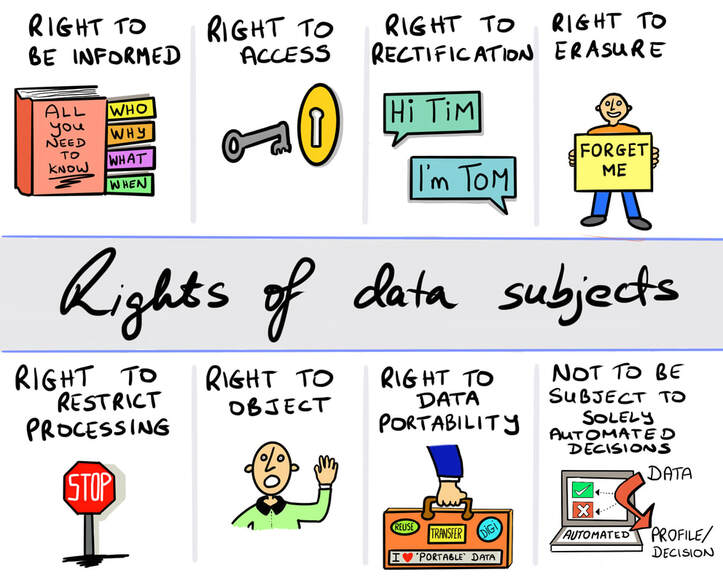
Rights of data subjects by Ronan Bree is licensed under CC BY-ND.
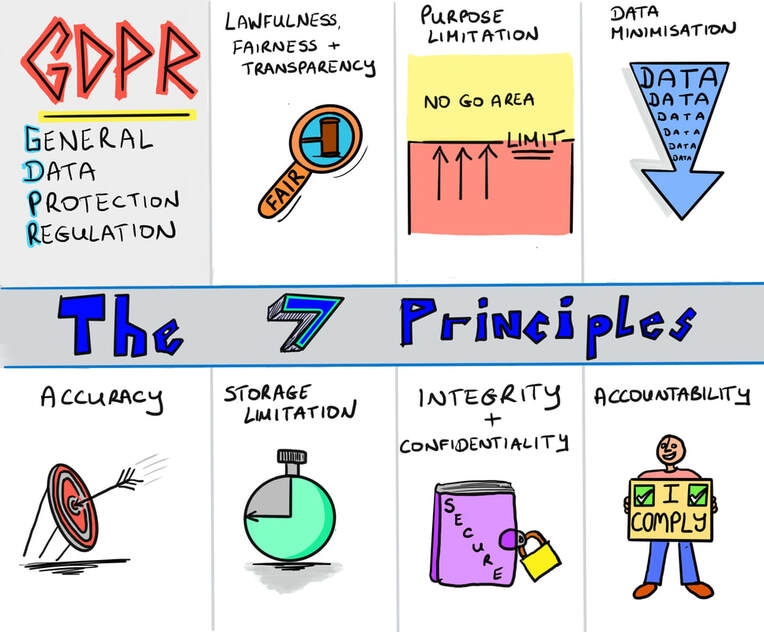
GDPR the 7 principles by Ronan Bree is licensed under CC BY-ND.
Two of my many takeaways is the need to always be proactive around data protection (privacy by design, from the onset), and the importance of a team of champions to be supporting both the work around this, and each other, within an organisation - oh, one more, encrypt your USB drives if they are deemed essential!
You can read more about the GDPR regulation and its articles here, while the Irish Data Protection Commission's website is a great resource also.
You can read more about the GDPR regulation and its articles here, while the Irish Data Protection Commission's website is a great resource also.