Domains & Typologies

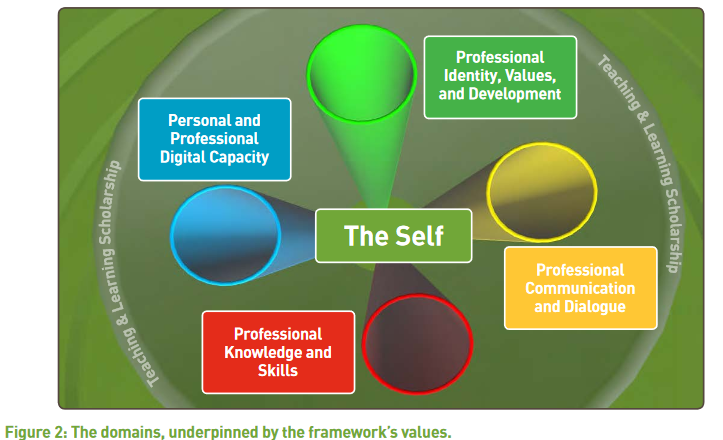
The NF Professional Development (PD) framework presents 5 overarching domains, that are each expanded with elements. The 5 domains are indicated in the accompanying figure, with some key points around each below:
Domain 1: Self: Personal values, perspectives & emotions that people bring to their teaching. Self-awareness, confidence, life experiences. Helps staff to understand their teaching philosophy.
Domain 2: Professional Identity, Values & Development in T&L: Development of critical reflection skills, evaluation of teaching, planning PD activities, consider identity in your context.
Domain 3: Professional Communication & Dialogue in T&L: Excellent, clear & coherent communication skills, recognises the importance of T&L in a community to enhance student learning, social dimension of T&L, communities of practice & networks.
Domain 4: Professional Knowledge & skills in T&L: Emphasises importance of both disciplinary knowledge & disciplinary approaches to teaching; also draws on inter-disciplinary experiences; supports active student role in learning process; moving towards partnership; capacity to design and implement innovations; learner oriented, dialogic feedback, assessment of/for/as learning; contribution to policies, procedures, scholarship.
Domain 5: Personal and Professional Digital Capacity in T&L: Capacity and application of digital skills and knowledge in practice; personal confidence & competence development around technologies to support & enhance student learning.
An intriguing self-assessment exercise earlier in the PACT course helped position each element of the domains. Overall, engaging with the domains has stimulated some deep reflection. It made me realise how so many aspects of my teaching are inter-connected, and the combination of my own experiences centre around the 'self'. A nice observation from one of the facilitators drew out attention to the text surrounding the domains - T&L scholarship. Great to see that presented in the accompanying figure also, as having both benefitted from, and contributed to, this aspect, I feel it is all encompassing with potential to 'touch' on all the domains.
PD can take place in so many diverse forms, with contribution from an array of sources - including within! Many reported previously that capturing the elements of their PD was difficult. In recent years, the broadening of ePortfolio possibilities has provided numerous avenues to assist, to collate and display evidence and reflections.
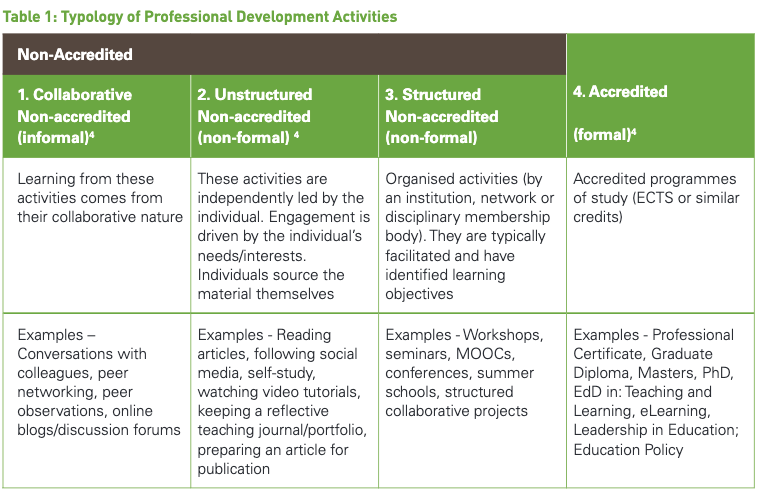
Going back to the framework, consideration has been given to all forms of PD activities and how they can be 'classified' or categorised. Engaging with Table 1 of the framework document allows you to consider activities that are non-accredited (including collaborative, unstructured and structured) and those that are accredited, such as a masters etc. Very helpful to get you started with how you could categorise your PD in recent times - as well as realise the extent of PD we are often engaged with.
Going back to the framework, consideration has been given to all forms of PD activities and how they can be 'classified' or categorised. Engaging with Table 1 of the framework document allows you to consider activities that are non-accredited (including collaborative, unstructured and structured) and those that are accredited, such as a masters etc. Very helpful to get you started with how you could categorise your PD in recent times - as well as realise the extent of PD we are often engaged with.