A.I. as a blogpost coauthor - wait, what?! (Sept 2023)
In recent months, I’m not sure many have missed announcements or discussions around the various Artificial Intelligence (AI) platforms both developed and released. Every time I scroll through twitter, I seem to quickly come across numerous AI discussing tweets or threads - without fail. I’ve been reading around this topic in recent weeks, and given I work in higher education, am very aware the associated challenges, opportunities and possibilities it brings to the fore. Today, I attended an NTUTORR masterclass on Academic Integrity and Assessment, which centred a lot on AI in Higher Education (HE). Three excellent guest speakers (Pieta Sikstrom, Rebecca Awdry, Billy Kelly) guided us through a fascinating and thought-provoking set of presentations, while the 'chat' on zoom was exceptionally active amongst attendees. I’m not sure I’ve seen so many comments in such a short space of time! There is no doubt that this topic is certainly on people’s minds.
So.....to the main element of my blogpost today…..and introducing my fellow, guest co-author for this particular blog post - AI.
After the masterclass session earlier, I was curious to explore whether AI could generate suitable text around itself in Higher Education. So I went to an online AI tool, and I added [1] a potential post title, [2] a description of the intended audience/persona ["An audience of academics interested in artificial intelligence's impact on higher education, on academic integrity and on assessment"], and then [3] some relevant key words ["Assessment, artificial intelligence, ChatGPT, opportunity, challenge, ai, ai literacy, academic integrity, success, students, educators, authentic assessment"]. That is all I entered. The platform then structured headings and key bullet points across several sections. I then pressed go/write….and below, in the blue box, shows you exactly what was produced by the platform (within about 3 seconds). I didn’t do any editing apart from correcting US to UK spelling in a few instances (...ized to ...ised).
Enjoy reading my guest c-author’s contribution below....even if you only have a short amount of time right now, even pick one paragraph below to read.....Do you think the text produced and points made are relevant and accurate to this topic/discussion?
So here we go!....
All text in the blue box below was written by AI.
The rise of artificial intelligence (AI) has revolutionised many aspects of our lives, from how we shop to how we interact with each other. But what does AI mean for higher education in universities? As academics concerned about the impact of AI, we must consider both the opportunities and challenges it presents for students and educators.
INTRODUCTION
AI is a type of computer programming that enables machines to emulate human behaviour and reasoning. It is becoming increasingly accessible and powerful, enabling machines to understand complex tasks and make decisions without direct instruction. This has created exciting opportunities for educational institutions, such as the use of AI-powered tools to automate tasks, enhance learning experiences, and provide personalised feedback to students. However, some academics have raised concerns about the potential impact of AI on academic integrity and assessment. As AI technology becomes more sophisticated, there are fears that it may replace authentic assessment methods with automated solutions that lack the nuanced understanding of a human.
OPPORTUNITY
AI provides a range of benefits for students and educators. For students, AI-powered tools can offer personalised instruction and feedback at scale, allowing them to get tailored help in areas they need it most. AI-powered tools can also be used to improve access to education for underserved populations, such as those with disabilities or in remote locations. For educators, AI can provide assistance with administrative tasks such as grading and course design. AI-powered tools like ChatGPT can be used to generate custom-made content for lectures and assignments quickly and accurately. These tools can also be used to identify patterns in student behavior, allowing teachers to better tailor their instruction to their students’ needs.
CHALLENGE
While AI offers a range of benefits for students and educators, it also poses challenges for higher education. One of the most significant is the potential impact on academic integrity and assessment. Automated tools such as plagiarism checkers may be used to detect cheating but lack the nuanced understanding of a human teacher. This raises serious questions about the accuracy of automated assessment methods and the potential for AI to replace authentic assessment. Another challenge posed by AI is the need for universities to develop AI literacy among both students and educators. As AI-powered tools become more commonplace in higher education, students must be equipped with the knowledge and skills necessary to understand them and use them effectively. Similarly, educators must be able to assess the strengths and weaknesses of AI-powered tools and evaluate their efficacy in teaching and assessment.
SUCCESS
To ensure success in the AI era, universities must take a proactive approach to developing AI literacy among both students and educators. This should include providing resources such as workshops and online courses on AI topics like machine learning, data science, and natural language processing. Universities should also consider providing support for faculty members who wish to incorporate AI into their teaching practice or research projects.
Universities should also strive to find the balance between using AI-powered technologies and maintaining authentic assessment methods. For example, universities could use AI-powered tools such as plagiarism checkers alongside more traditional methods like essay writing or oral exams. This approach would allow universities to benefit from the advantages that AI offers while still ensuring that students are assessed fairly and accurately based on their knowledge and understanding.
CONCLUSION
The rise of artificial intelligence presents both opportunities and challenges for higher education. On one hand, AI can provide students with personalised instruction and feedback at scale, while also helping educators automate tedious tasks such as grading. On the other hand, there are concerns about potential impacts on academic integrity and assessment. To ensure success in the AI era, universities must take a proactive approach to developing AI literacy among both students and educators, while also striving to find a balance between using AI-powered technologies and maintaining authentic assessment methods.
I, real Ronan!, am adding an "AI Generated Text Ends Here" statement here as I feel that is important point to make.
Also, I feel I will 'acknowledge' my "co-author"'s contribution at the end of this blogpost.
Also, I feel I will 'acknowledge' my "co-author"'s contribution at the end of this blogpost.
So back to the 'Real Ronan' now!
Are you as fascinated as I am? Is your mind thinking of the impact and potential around this technology? Such a small amount of input - just a title, a very short persona descriptor and some general key words. 3-seconds later, you have the above text to discuss the keypoints in context. It's easy to start considering threats with the dawn of AI, but equally important to identify opportunities.
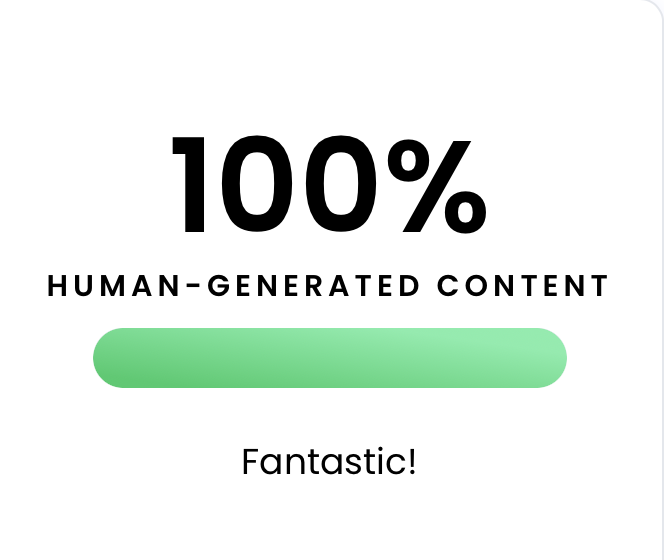
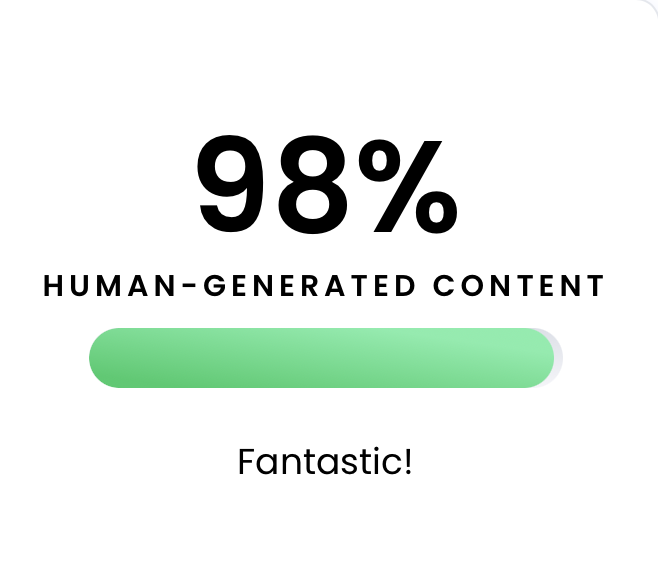
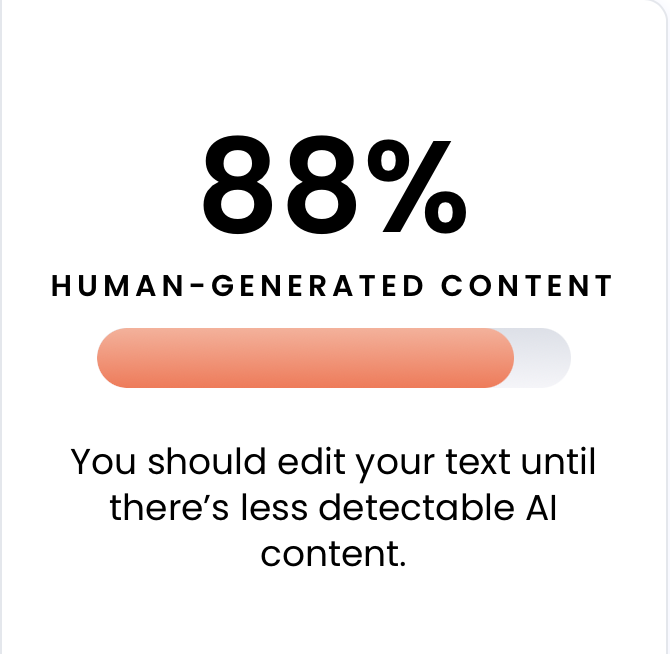
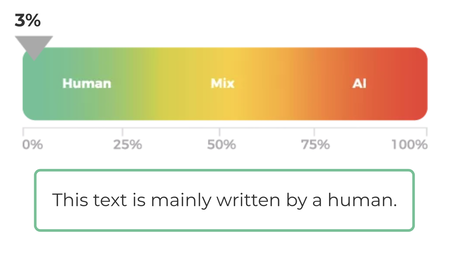
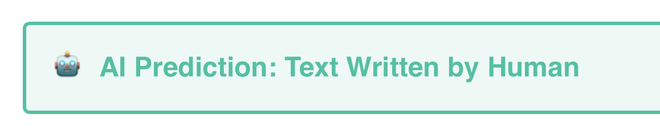
To see about AI detection with the above piece text generated, I ran it through an AI checker, just to see what it looked like (FYI - I had to break it up into sections in some cases based on the word limits of some checkers, but essentially, bottom line, the text is being detected as human generated content in three separate instances). See below:
....and another checker....
....and another checker....
At the NTUTORR masterclass event, NAIN's Billy Kelly mentioned the need for us to develop AI Literacy, and as a community this will indeed be vital. We also saw some 'chat' comments around training being required, to support people to be proactive vs. reactive, and to work with students, and to reflect on assessment types. This AI technology is fully and freely available now, and functional, so we need to reflect, we need to think more about its integration in society, and how we can build awareness, and work collaboratively, to consider potential opportunities around AI in HE.
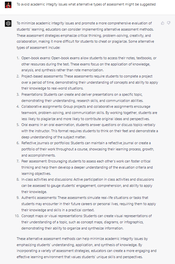
Sue Beckingham (@suebecks) mentioned in the masterclass/webinar's 'chat' how she had asked ChatGPT4:
"To avoid academic integrity issues what alternative types of assessment might be suggested?"
Some highly relevant considerations identified in the output it provided are very applicable to this AI discussion too (link to the output here: http://doi.org/10.25416/NTR.22303540.v1 )....or click the side image of the output to review/read through.
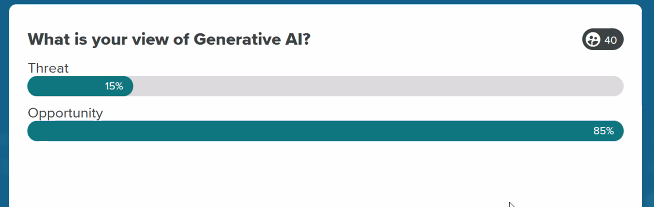
Also it's worth noting the outcome of an interesting attendee poll completed towards the end of the masterclass session earlier today .... #opportunity
One of the presenters (Pieta Sikstrom of the University of Jyväskylä) shared a video created by her colleague, Mikko Rönkkö, in which he speaks about four use cases of GPT in Higher Education. I link it here too as it may be of interest....
FYI - The recording of the masterclass will be available online to access shortly at http://www.ntutorr.ie/ and https://www.digitaled.ie/webinars-events/ntutorr-project-masterclasses/ .
Acknowledgements: Sincere thanks (?!) to my fellow coauthor, Artificial Intelligence at Moon Beam, who provided a helpful overview of several key challenges and opportunities of AI in HE.
Certainly food for thought for us all in HE......not only around academic integrity, authenticity, credibility, assessment, employability etc., but also around how (and potentially 'what'!) we teach and learn. Collective efforts across the sector at all levels, across campuses and national bodies will be needed to move forward together in this space.
Certainly food for thought for us all in HE......not only around academic integrity, authenticity, credibility, assessment, employability etc., but also around how (and potentially 'what'!) we teach and learn. Collective efforts across the sector at all levels, across campuses and national bodies will be needed to move forward together in this space.